The rain began just after sunset.
From the terrace of his crumbling apartment in Hazratganj, Aarav watched the storm swallow Lucknow inch by inch. Neon lights trembled in puddles. Minarets disappeared behind curtains of rain. Somewhere in the distance, the azaan drifted through the city like a memory refusing to die.

He lit a cigarette he did not want.
The newsroom had suspended him three weeks ago after his investigation into land scams connected to ministers in Gomti Nagar. Officially, he was “on leave.” Unofficially, he had become inconvenient.
His phone vibrated.
Unknown Number.
No message. Only a location pin.
Bara Imambara
11:30 PM.
Aarav stared at the screen for a long moment before slipping his revolver into his jacket.
Something in his gut told him this was not a trap.
It was worse.
The city looked haunted at night.
Rickshaws splashed through flooded roads. Tea stalls steamed under yellow bulbs. Men huddled beneath tarpaulins discussing politics and cricket while thunder rolled above the domes of old Lucknow.
When Aarav reached the vast courtyard of the Bara Imambara, the rain had slowed to a whisper. The monument loomed like a sleeping giant beneath the storm clouds.
A figure stood near the staircase.
An old man in a cream sherwani.
“Late,” the stranger said softly.
“You summoned me.”
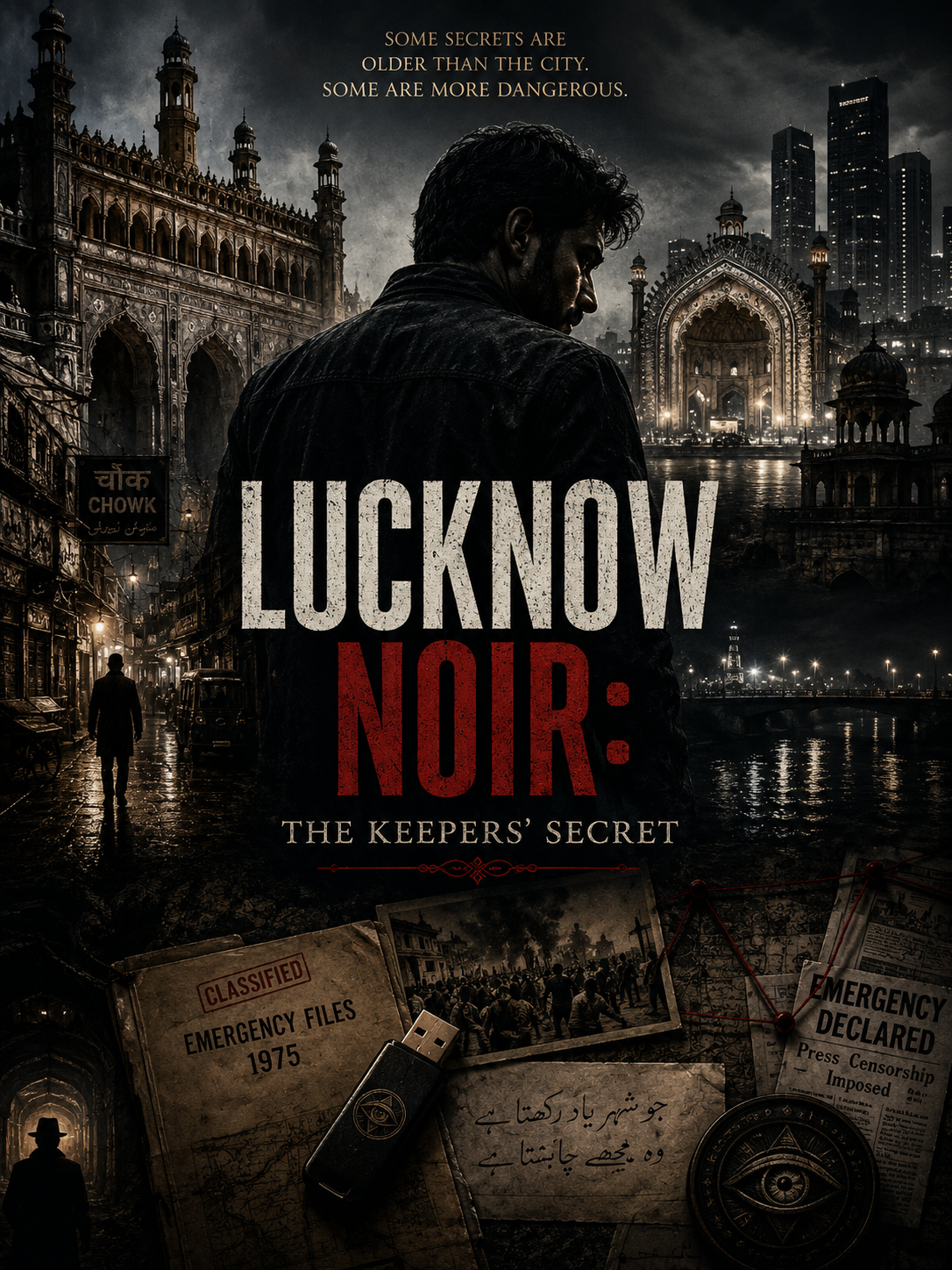
The old man smiled faintly and handed him a small black pen drive.
“Some truths,” he murmured, “survive only because someone dangerous remembers them.”
Before Aarav could ask another question, headlights flashed across the courtyard.
The old man froze.
Then came the gunshot.
Aarav ducked instinctively as the stranger collapsed backward onto the wet stone steps, blood mixing with rainwater.
Black SUVs burst through the gates.
Aarav ran.
The labyrinth of Bhool Bhulaiyaa twisted around him like a nightmare.
Footsteps thundered behind him.
He darted through narrow corridors, his breath ragged, shadows stretching across ancient walls. Somewhere below, men shouted orders.
“Seal the exits!”
He nearly slipped before finding a hidden staircase spiraling downward into darkness.
At the bottom, he crouched behind a pillar, clutching the pen drive like it was radioactive.
The voices faded.
Only then did he hear another sound.
A woman’s voice.
“You should not have come.”
Aarav spun around.
She stood beneath an archway wearing a black kurta, rain dripping from her hair, eyes sharp as broken glass.
“Who are you?”
“Someone trying to keep you alive,” she replied.
“My name?”
“I know everything about you, Aarav Malhotra.”
That unsettled him more than the gunfire.
She stepped closer.
“The man upstairs was Professor Rizvi. Former historian. Former intelligence analyst. He spent thirty years collecting evidence about a group called The Keepers.”
“The Keepers?”
Her silence answered enough.
“They killed him because he contacted you.”
“And you?”
She hesitated.
“Call me Zoya.”
Back in his apartment, Aarav inserted the pen drive into his laptop.
Hundreds of encrypted folders appeared.
Photographs.
Surveillance footage.
Bank transactions.
Government files stamped CONFIDENTIAL.
And one repeated symbol.
A black circle with an eye inside it.
The Keepers.
A video file began playing automatically.
An elderly man appeared on-screen—Professor Rizvi.
“If you are watching this,” he said calmly, “then I am already dead.”
Aarav’s throat tightened.
“The Keepers were born during the Emergency of 1975. Politicians, intelligence officers, industrialists—they created a shadow network to control unrest through fear and information. Over decades they infiltrated media houses, courts, police departments, universities.”
The professor leaned closer to the camera.
“But their greatest weapon is not violence.”
A pause.
“It is memory.”
Static flickered.
Then the screen cut to black.
The next morning, Lucknow buzzed with news of the professor’s “heart attack.”
No mention of gunshots.
No mention of witnesses.
State Minister Samar Pratap appeared on television offering condolences.
Aarav nearly dropped his tea.
Samar Pratap.
The city worshipped him.
Educated. Sophisticated. A patron of Urdu poetry and heritage restoration. He quoted Ghalib in speeches and donated millions to old monuments across Lucknow.
And according to the files—
He was one of The Keepers.
Aarav’s phone rang again.
Zoya.
“Meet me in Chowk,” she whispered. “And don’t come directly.”
The old lanes of Chowk were alive with chaos.
Vendors shouted over each other. Kebabs sizzled over charcoal. Perfume sellers waved crystal bottles beneath passing noses.
But Aarav noticed the same white Scorpio trailing him for three streets.
He slipped into a crowded alley.
The Scorpio stopped.
Two men stepped out.
Clean-shaven.
Military posture.
One touched his earpiece.
Aarav moved faster.
He crossed spice markets, vaulted a vegetable cart, and disappeared into a narrow lane beside an ancient mosque.
Someone grabbed his wrist.
Zoya pulled him through a hidden doorway moments before the men reached the alley.
Inside was an abandoned haveli.
Dust floated through shafts of light. Torn curtains swayed like ghosts.
“You’re being tracked,” she said.
“How?”
She pointed toward his watch.
Aarav removed it immediately.
“Who are these people?”
“The surveillance wing of The Keepers.”
“You talk like you know them well.”
Zoya looked away.
“I used to work for them.”
Silence filled the room.
Then she handed him an old diary.
Leather-bound.
Inside were handwritten Urdu couplets.
Aarav frowned.
“This is poetry.”
“It’s code.”
He studied the page carefully.
‘Jo sheher yaad rakhta hai, woh kabhi azaad nahi hota.’
The city that remembers is never truly free.
Coordinates were hidden between the verses.
One location repeated again and again.
Rumi Darwaza
Midnight.
Rain returned that night.
The massive gateway stood illuminated against the darkness, magnificent and menacing.
Aarav and Zoya searched beneath the structure until they found a concealed iron hatch buried beneath weeds.
It opened into underground tunnels.
Ancient nawabi escape routes.
Their footsteps echoed as they descended deeper below the city.
The tunnel walls were lined with old photographs.
Protests during the Emergency.
Disappearances.
Mass arrests.
Faces scratched out in red ink.


At the end of the passage stood a steel door.
Inside was a hidden archive.
Documents filled shelves from floor to ceiling.
Video tapes.
Hard drives.
Government seals.
Evidence.
Enough to destroy ministers, judges, business tycoons.
Enough to burn the nation.
Aarav’s pulse quickened.
“This is it,” he whispered.
Then applause echoed through the chamber.
Slow.
Deliberate.
Samar Pratap emerged from the shadows.
Perfectly dressed in a charcoal sherwani.
Smiling.
“I wondered how long it would take you.”
Men with rifles surrounded them instantly.
Zoya reached for her weapon—
But Samar raised a hand.
“No violence,” he said gently. “Not yet.”
He looked at Aarav almost affectionately.
“You remind me of myself when I was young. Angry. Idealistic. Reckless.”
“You murdered Rizvi.”
“Rizvi endangered stability.”
“You manipulate history.”
Samar smiled faintly.
“My dear boy, history is manipulation.”
He walked slowly through the archive.
“Countries are not held together by truth. They are held together by carefully edited memories.”
Lightning flashed aboveground.
Samar’s face briefly vanished into darkness.
“You think exposing corruption changes anything? The public forgets within days. Fear lasts longer. Stories last longer. We merely guide them.”
Aarav clenched his fists.
“You’re monsters.”
“No,” Samar replied calmly. “We are caretakers.”
Then his eyes shifted toward Zoya.
“And traitors disappoint me.”
Aarav turned sharply.
Zoya’s face hardened.
“You lied to me.”
“I was assigned to monitor you,” she admitted quietly. “But things changed.”
Before Aarav could react, gunfire erupted.
The lights exploded.
Chaos consumed the chamber.
Zoya grabbed Aarav’s arm.
“Run!”
They sprinted through collapsing tunnels as bullets tore through stone walls. Dust choked the air. Somewhere behind them, men screamed.
The underground archive began burning.
By dawn, Lucknow awoke to disaster.
An explosion beneath old city tunnels.
Authorities blamed illegal gas storage.
But Aarav knew better.
The evidence was gone.
Almost all of it.
Almost.
Because hidden inside his jacket was one surviving hard drive.
Three days later, Gomti Nagar glittered beneath thousands of lights as politicians, industrialists, and media executives gathered for Samar Pratap’s cultural gala.
The elite of Lucknow arrived dressed in silk and diamonds.
Television cameras flashed endlessly.
Inside the ballroom, Samar delivered a speech about heritage and democracy while musicians played softly in the background.
Then every screen in the hall flickered.
Static.
The music stopped.
A video appeared.
Emergency footage.
Political assassinations.
Surveillance operations.
Secret financial records.
Faces of The Keepers.
Gasps rippled through the ballroom.
Samar froze.
Aarav stepped onto the stage.
The hall erupted into panic.
“You wanted control over memory?” Aarav shouted. “Tonight the city remembers everything.”
Police sirens wailed outside.
Journalists surged forward.
Some guests fled.
Others stared in horror.
For the first time, Samar looked afraid.
But only briefly.
Then he smiled again.
That terrified Aarav most.
Because the politician did not look like a defeated man.
He looked like a man adjusting to inconvenience.
Gunshots rang out.
Lights shattered.
The ballroom descended into madness.
Aarav lost sight of Zoya in the chaos.
Someone tackled him.
Another shot.
A scream.
Then darkness.
When Aarav awoke, dawn light filtered through hospital curtains.
Television screens blared nonstop coverage.
“Massive Political Conspiracy Exposed.”
“Emergency-Era Network Under Investigation.”
“Minister Samar Pratap Missing.”
Missing.
Not arrested.
Missing.
A nurse informed Aarav that Zoya had disappeared before police arrived.
No records.
No identity.
Nothing.
As though she had never existed.
Weeks passed.
Governments shifted.
Committees formed.
Arrests were announced.
But slowly, subtly, stories changed.
Channels stopped discussing The Keepers.
Witnesses retracted statements.
Files vanished.
Public outrage faded into distraction.
One evening Aarav returned alone to the Gomti Riverfront.
The city shimmered quietly beneath the twilight.
Children laughed nearby.
Couples walked past street vendors.
Life continued.
His phone buzzed.
Unknown Number.
A single message appeared.
The Keepers were never the people.
They are the idea that truth must always serve power.
No one destroys an idea.
Aarav stared at the message as the screen went dark.
Across the river, the skyline of Lucknow glowed beautifully beneath the night sky.
Elegant.
Ancient.
Dangerous.
And somewhere within its shadows, unseen eyes were still watching.












 https://www.youtube.com/watch?si=RtToJsBhYBatUrym&v=mOuYNSdhjHA&feature=youtu.be